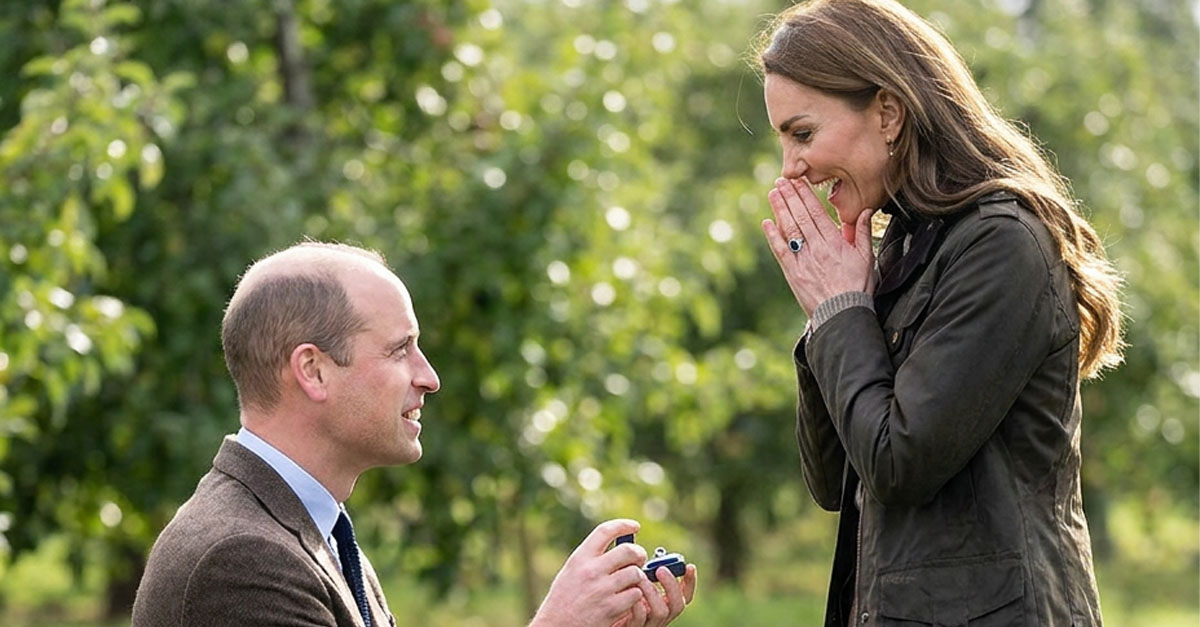
A tale about Prince William dropping to one knee before Catherine, Princess of Wales, has all the ingredients of a royal romance: a private palace room, a mysterious box, tears, and the touching line, “If I had to choose all over again, I would still choose you.” It is an irresistible scene—but there is an important distinction between an appealing story and a verified report.
There is no reliable public evidence that William staged this anniversary moment, said those 12 words, or presented Kate with a secret gift. The story should therefore be treated as an unverified claim, not as established news. Looking at the couple’s real milestones offers a more informative picture of their relationship—and helps explain why such stories spread.
What the Viral Story Claims
The account describes William kneeling before Kate in a “secret room” at the palace to mark a 15-year milestone. It says he ignored cameras and royal protocol, repeated a gesture associated with his proposal, and gave her a mysterious item from a small box.
But the story leaves out the details readers would need to assess it: the precise date and location, who witnessed the moment, where the quotation originated, and whether the couple or Kensington Palace confirmed it. Without a traceable source, vivid details do not make an anecdote factual.
The Real Milestones in William and Kate’s Relationship
William and Kate met while studying at the University of St Andrews in Scotland. Their relationship developed away from public duties for several years before their engagement was announced in November 2010.
William proposed during a private trip to Kenya, using the engagement ring that had belonged to his mother, Diana, Princess of Wales. The couple married at Westminster Abbey on April 29, 2011. Their wedding was a major public event, but the proposal itself was described as a private occasion.
That distinction matters: a real event can inspire a fictional embellishment. The familiar image of William proposing on one knee may make a supposed anniversary reenactment sound plausible, but it does not verify that it happened.
The “15-Year Milestone” Needs a Date
The phrase “15-year milestone” is ambiguous. William and Kate’s wedding anniversary falls on April 29. Their engagement was announced in November 2010, while their first meeting and the start of their relationship are often discussed in connection with their university years.
Those are different milestones, and they do not share the same anniversary date. A credible account should say which event is being marked and give a date. Without that information, readers cannot easily check whether the story fits the couple’s public timeline.
What About the 12 Words and the Mysterious Box?
The quotation—“If I had to choose all over again, I would still choose you”—is presented as a direct statement from William. Yet no reliable, attributable source is supplied for it. It should not be repeated as a confirmed quotation.
The same caution applies to the box and its alleged contents. The story does not identify the gift or explain how anyone learned about it. Since the scene is described as private, readers should ask whether the account names a credible witness or cites a reputable publication. If it does neither, the supposed gift remains speculation.
Why Royal Romance Stories Travel So Quickly
Romantic royal stories are highly shareable because they combine familiar people with emotionally satisfying details. A proposal-like gesture, an intimate quotation, and a secret present create a complete miniature story that readers can picture immediately.
Social media headlines may also use suspenseful questions—such as “What was inside the box?”—without providing evidence that the box existed. That framing can blur the line between reporting and storytelling. Repetition across websites or posts does not independently confirm a claim, particularly when they all appear to rely on the same unsupported source.
How to Check a Celebrity or Royal Claim
Before treating a dramatic anecdote as fact, consider a few simple questions:
- Is there a named, reliable source? Look for reporting from an established publication, an official statement, or a clearly identified firsthand witness.
- Can the quote be traced? Direct quotations should have a source and context, not merely quotation marks.
- Are key details provided? Dates, locations, and the nature of the milestone make a story easier to verify.
- Do independent outlets confirm it? Several sites repeating identical wording may not amount to multiple independent reports.
- Does the headline promise more than the article proves? A teasing question is not evidence of the event it implies.
These checks are useful for royal news and for viral stories about celebrities, public figures, and major events more generally.
A More Grounded View of Their Public Story
The details of William and Kate’s private relationship are not always public—and that is appropriate. What can be discussed responsibly are the milestones they have publicly shared: their university connection, their engagement announcement, their wedding, and their life as a family and working members of the royal household.
It is possible to appreciate the romantic idea behind the anniversary story without presenting it as fact. In this case, the claim may make for an emotional headline, but the kneeling gesture, the 12-word declaration, and the hidden gift have not been substantiated by reliable public evidence.
The story of Prince William kneeling before Princess Kate and offering her a secret anniversary gift is compelling, but it lacks the sourcing needed to establish that it happened. The couple’s real history already includes meaningful public milestones, while the details of their private life should not be filled in with invented certainty.
When a royal headline promises tears, a secret room, and a mysterious box, the most valuable question is not what might have been inside—but what evidence supports the story in the first place.