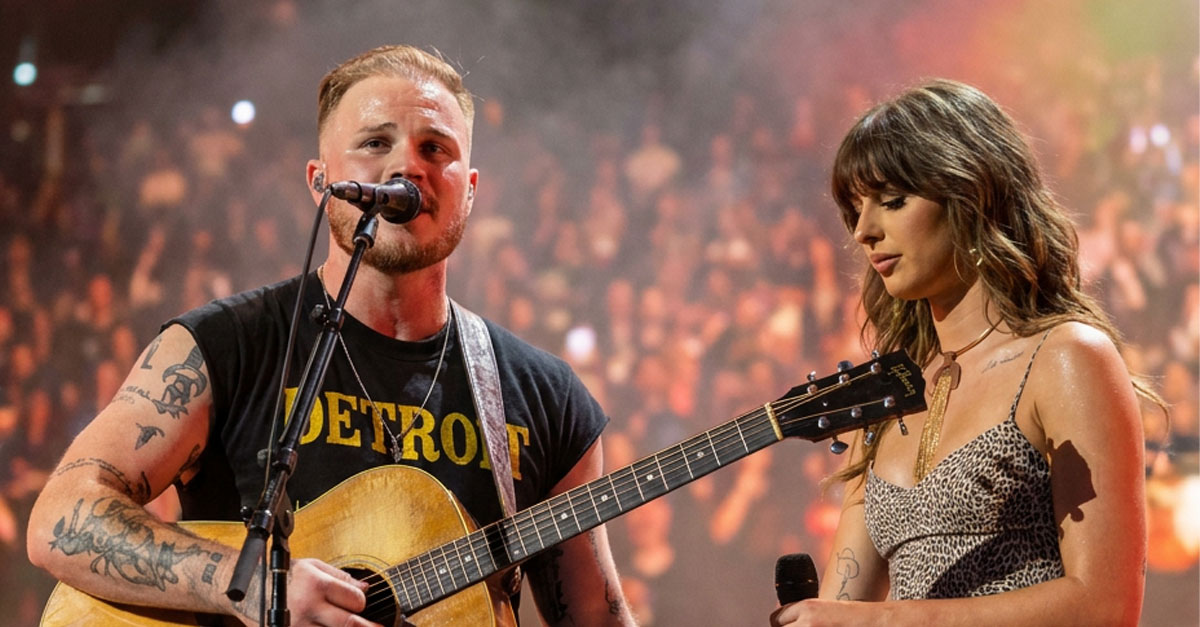
Zach Bryan took the stage at Gillette Stadium wearing a T-shirt bearing the words “Free Palestine” and “An appeal to Heaven.” He did not appear to address the message verbally during his set, but the shirt drew attention in a venue recently at the center of a dispute over pro-Palestinian expression.
Bryan is scheduled to perform a second show at the stadium on Saturday night. His appearance has prompted renewed discussion about how political messages are handled at concerts—and where organizers and artists draw the line between expression and speech they consider unacceptable.
A message onstage, without a spoken statement
Bryan’s shirt combined two distinct phrases. “Free Palestine” is a widely used call for Palestinian freedom and rights. “An appeal to Heaven” is a historic phrase that has also taken on contemporary political associations in the United States.
Although Bryan wore both messages in front of a large audience, he did not appear to explain them or make a related speech during the performance. That distinction matters: the shirt communicated a visible position, but the set itself did not include an apparent verbal statement about the Israel-Palestine conflict.
Without further comment from Bryan, it is not possible to say precisely what he intended by wearing the shirt or how he connects the two phrases.
The recent Macklemore dispute at Gillette
The setting gave Bryan’s shirt added significance. Gillette Stadium owner Robert Kraft was recently involved in removing rapper Macklemore from Ed Sheeran’s tour after Macklemore’s pro-Palestinian onstage messaging and performance of “Hind’s Hall,” his 2024 protest song.
Kraft said Macklemore’s appearance on the Gillette Stadium stage would cross a line into hate speech. The dispute brought attention to the difficult questions that can arise when performers use concert stages to communicate political views: who makes the decision about what is permitted, what standards are applied, and how those decisions affect artists and audiences.
The details of Bryan’s appearance differ from the Macklemore episode. Bryan wore a shirt with political messaging but did not appear to deliver a spoken statement during his set. The reported circumstances should not be treated as proof that the stadium or Kraft took the same position on Bryan’s clothing as on Macklemore’s performance.
Political expression at concerts
Concerts have long served as spaces where artists express views through lyrics, speeches, clothing, staging, and other choices. A message on a T-shirt is a form of public expression, but it can be less explicit than a spoken address or a song written around a specific cause.
That leaves room for interpretation. Some audience members may see a shirt as a straightforward expression of solidarity; others may read its wording or associations differently. In Bryan’s case, the absence of a verbal explanation means observers should be careful not to attribute a more detailed statement to him than the available facts support.
The venue matters, too. Stadiums are not simply private backdrops: they are major public-facing spaces, while also being operated by organizations that set policies and make decisions about events. Disagreements over political expression can therefore involve artists, venue owners, promoters, and audiences—all with different expectations and responsibilities.
What to watch for at Saturday’s show
Bryan’s scheduled second performance at Gillette Stadium may prompt further interest in whether he wears the same shirt, adds any comments, or leaves the matter unaddressed. Until the show takes place, those possibilities remain unknown.
For now, the reported facts are limited: Bryan wore a shirt reading “Free Palestine” and “An appeal to Heaven,” did not appear to speak about the subject during the set, and is due to perform again at the stadium Saturday night. Any claims about what he plans to do next should be treated as speculation unless confirmed by Bryan or his representatives.
Zach Bryan’s shirt has brought renewed attention to political expression at Gillette Stadium, especially following the controversy involving Macklemore and “Hind’s Hall.” The episodes are related by their setting and subject matter, but they are not identical: Bryan’s reported message appeared on clothing, while Macklemore’s involved onstage messaging and a protest song.
As Bryan prepares for his second show, the episode illustrates how even a brief visual statement can spark wider discussion about artists’ freedom to express political views, venues’ authority over their stages, and the care needed to distinguish confirmed details from interpretation.