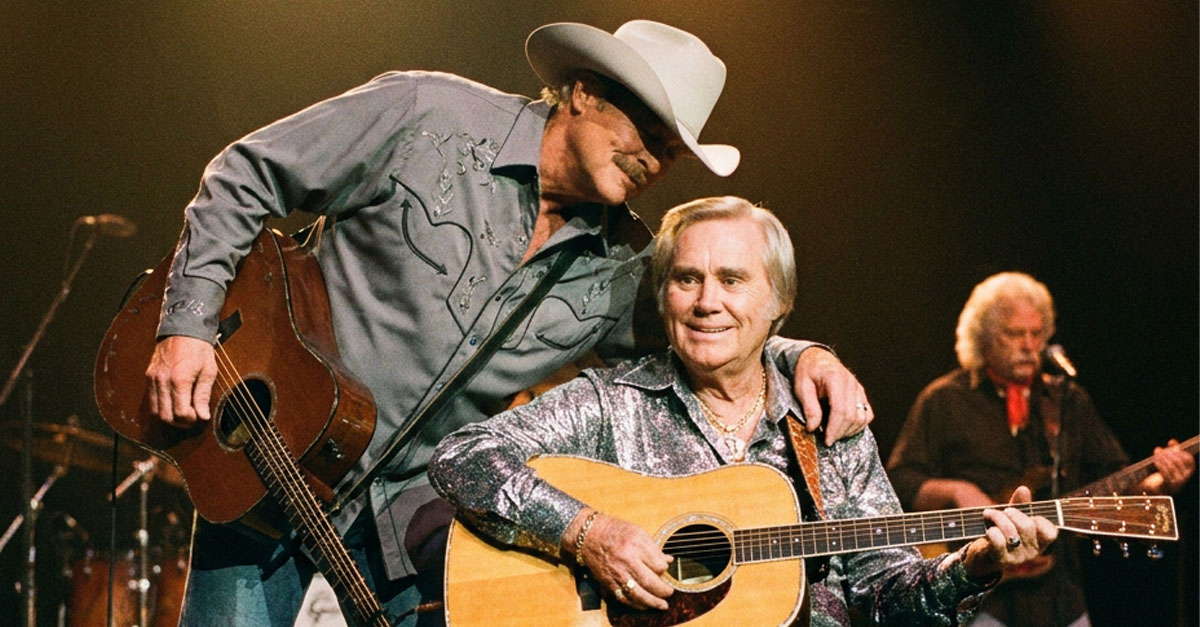
George Jones did not merely sing country music. He embodied its most essential qualities—raw honesty, emotional vulnerability, and the courage to transform private suffering into something listeners could feel in their bones. Known as the Possum, he possessed a voice of extraordinary control and expressive power that set the standard for the genre. Peers repeatedly named him the greatest country singer of all time. Johnny Cash once said no one had compared to him, while Waylon Jennings remarked that if every singer could sound the way they wanted, they would all sound like George Jones.
Born George Glenn Jones on 12 September 1931 in Saratoga, Texas, he grew up in hardship and absorbed the honky-tonk and gospel traditions that shaped early country. His career stretched from the mid-1950s into the twenty-first century, producing hit after hit and nearly 170 chart singles. Early successes such as “Why Baby Why,” the No. 1 “White Lightning,” “Tender Years,” and “She Thinks I Still Care” established him as a master of both upbeat numbers and aching ballads. Later recordings, including “The Grand Tour” and the duets he recorded with Tammy Wynette, deepened his reputation as the king of broken hearts.
The song that cemented his place in history arrived in 1980. “He Stopped Loving Her Today,” written by Bobby Braddock and Curly Putman, tells of a man who carries an unrequited love until the day he dies. Jones initially resisted the track, calling it morbid, yet his performance elevated the lyric into one of the most revered recordings in country music. It reached No. 1, became his first million-seller, won a Grammy, and revived a career that had been faltering. Listeners still cite it as the definitive expression of country emotion—sorrow rendered with restraint, dignity, and devastating clarity.
What gave Jones’s singing its unmatched authority was the life behind it. He endured poverty, four marriages (most famously the turbulent union with Tammy Wynette from 1969 to 1975), severe alcoholism, drug addiction, financial collapse, and a reputation for missed performances that earned him the nickname No-Show Jones. These struggles were not hidden; they became part of the music. Songs such as “If Drinkin’ Don’t Kill Me (Her Memory Will)” and “These Days (I Barely Get By)” carried the weight of lived experience. When Jones sang of heartbreak, regret, or the slow damage of hard living, audiences believed him because the pain was real. His voice could bend a note until it hurt, holding back emotion just long enough for the listener to feel the full force of its release.
This authenticity is what distinguishes Jones’s contribution. Country music has always valued storytelling rooted in ordinary hardship, yet few artists lived the stories as fully or conveyed them as purely. He helped carry the genre from rural honky-tonks into the American mainstream while preserving its emotional core. Later generations—from Randy Travis and Dwight Yoakam to contemporary country artists—have cited him as the vocal model they still try to approach. His phrasing, the way he inhabited a lyric rather than merely performing it, remains a benchmark.
Jones died on 26 April 2013 in Nashville at the age of 81. By then he had received the Country Music Hall of Fame honor, multiple Grammy awards, and the enduring admiration of both fans and fellow musicians. His life was imperfect, marked by repeated falls and hard-won recoveries. Yet the music that emerged from those years stands as proof that the greatest country songs are not manufactured. They arise from authenticity, from the vulnerable depths of pain, and from the courage to turn life’s hardships into something lasting and beautiful. In George Jones, country music found its purest voice.