On 21 April 2026, Buckingham Palace hosted a reception marking what would have been Queen Elizabeth II’s 100th birthday. Among the working royals gathered for the occasion were the Prince and Princess of Wales and the Duke and Duchess of Edinburgh. Their presence side by side prompted media commentary that the four now form a new senior grouping at the heart of the modern monarchy—sometimes called a successor to the earlier “Fab Four.”
The event brought together roughly 190 guests in the Palace’s Marble Hall. King Charles and Queen Camilla led the commemorations, with a formal family photograph that included the wider working royal family. Within that setting, William, Catherine, Edward and Sophie were observed standing together, conversing and marking the day. Catherine wore a light pink A-line dress; Sophie chose a white shirt dress with a riding-boot print, a quiet nod to the late Queen’s lifelong love of horses. Edward wore a red tie decorated with horses. The details were small, but they underscored a shared sense of occasion.
The gathering was one of several tributes that day. Earlier, members of the family had viewed design proposals for a Queen Elizabeth memorial in St James’s Park. Social-media posts from the Waleses shared archival images, including photographs of the late Queen with younger members of the family. The overall tone combined formal remembrance with a sense of continuity. The late Queen’s long reign remains a reference point for the current generation of working royals, and the centenary reception offered a public setting in which that continuity could be seen.
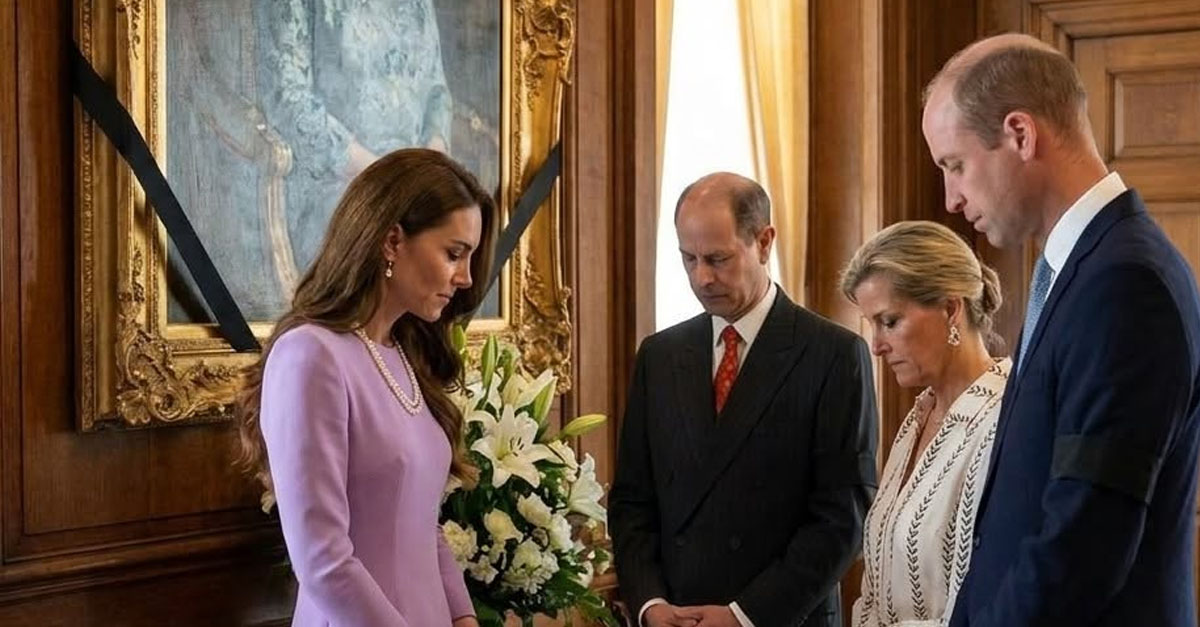
Observers noted the practical strength of the quartet. William and Catherine carry the heaviest public schedule as the next generation. Edward and Sophie have long been regarded as reliable, low-drama figures whose workload has increased in recent years. Sophie in particular developed a close relationship with the late Queen and has become one of the most consistently active working royals. Their joint appearance at the centenary did not require dramatic staging; simply standing together in the same room signalled a stable, collaborative core.

No official statement described a specific silent vow or a staged moment of collective bowing before a portrait. What the photographs and reports show is a group of senior royals present, composed, and engaged in the same act of remembrance. In an institution that values continuity, such images carry weight precisely because they are understated. The late Queen’s portrait and memory were central to the day; the four royals’ presence was part of how that memory was publicly acknowledged.
The centenary reception also illustrated how the working monarchy has adjusted since 2022. With fewer full-time working royals than in earlier decades, the visible partnership of William, Catherine, Edward and Sophie has taken on greater importance. Their appearance together on 21 April was neither a replacement for the wider family photograph nor a declaration of a new formal structure. It was simply a clear example of four senior figures performing the same duty on the same day.
For many who follow the monarchy, the lasting impression of the centenary was one of continuity rather than spectacle. Queen Elizabeth II’s 100th birthday was marked by family, guests, and a series of public tributes. Within that programme, the Prince and Princess of Wales and the Duke and Duchess of Edinburgh stood together—quietly reinforcing the idea that the work of the Crown continues through a small, steady group of working royals.