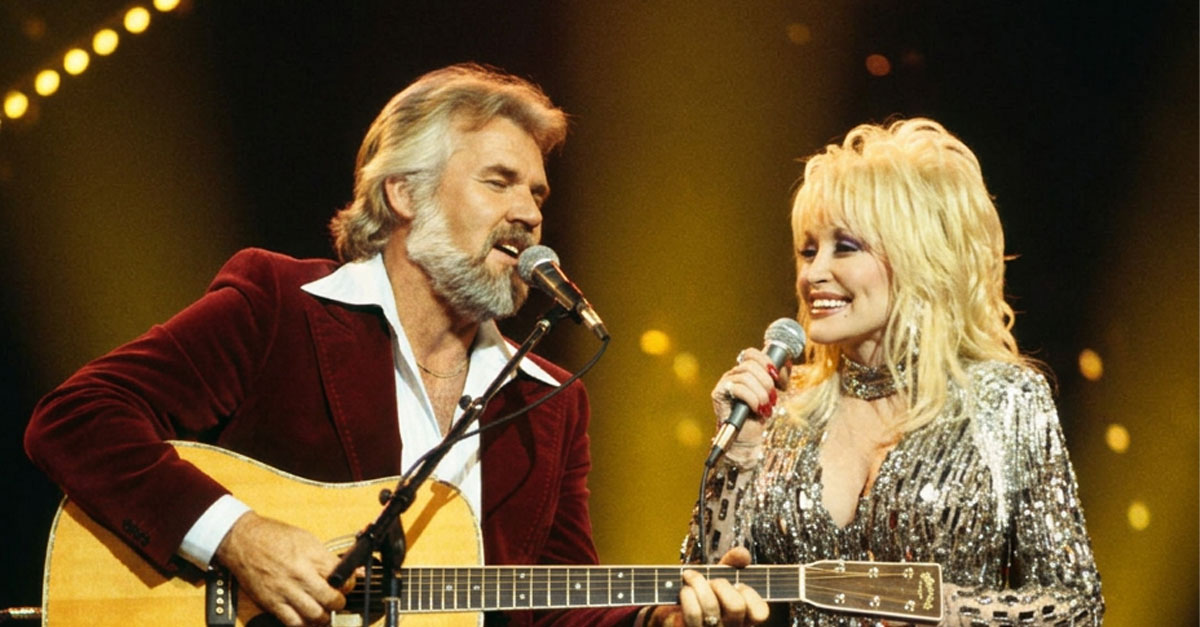
Some duets are impressive because of their vocal power. Others succeed because the singers blend so perfectly that their individual identities seem to disappear. But Kenny Rogers and Dolly Parton achieved something rarer on their 1990 recording of “Love Is Strange”: they made the song feel completely natural.
Their version of the Mickey & Sylvia classic is not merely a competent remake or a convenient pairing of two country icons. It is a persuasive demonstration of what happens when chemistry, trust, and personality matter as much as melody. Kenny and Dolly do not just sing together—they converse. And that conversational quality is precisely why the performance remains so memorable.
They Turn a Familiar Song Into Something Personal
“Love Is Strange” has always carried a playful premise: love can be confusing, unpredictable, and difficult to explain. Rather than treating the song as a straightforward romantic number, Kenny and Dolly lean into its conversational spirit.
Kenny brings his familiar warmth and steady calm. His voice gives the performance a grounded, reassuring center. Dolly, meanwhile, responds with her unmistakable sparkle, wit, and gentle humor. The contrast between them creates movement. One voice sets up the feeling; the other reacts to it. The song develops not through dramatic vocal competition, but through timing and personality.
That makes the recording feel less like two stars sharing a microphone and more like two people exchanging thoughts about love. Their delivery suggests teasing, affection, curiosity, and just enough skepticism to make the sentiment believable.
Their Chemistry Is More Important Than Vocal Showmanship
It would be easy to argue that the appeal of a duet should rest primarily on vocal power. After all, Kenny Rogers and Dolly Parton were both accomplished singers, and audiences could reasonably expect a dazzling display of technique.
Yet “Love Is Strange” proves that restraint can be more compelling than vocal fireworks.
Neither performer tries to overpower the other. Kenny does not dominate with his deep, unmistakable voice, and Dolly does not turn every line into a showcase for her range or signature vocal flourishes. Instead, they give each other room. Their pauses, responses, and shared phrasing create the impression that they are listening as carefully as they are singing.
That generosity is central to the song’s charm. The performance works because neither artist is trying to win. They are trying to connect.
The Song Feels Authentic Because Their Friendship Comes Through
The history between Kenny Rogers and Dolly Parton gives the recording an emotional dimension that cannot be manufactured easily. They were longtime friends and musical partners, and their familiarity is audible in the performance.
There is an ease in the way they interact—a sense that they understand one another’s timing and instincts. The smiles seem genuine. The humor feels unforced. Even the romantic subject matter avoids becoming overly sentimental because the singers approach it with the relaxed confidence of people who already trust each other.
This does not mean the recording should be mistaken for a private exchange in the literal sense. It is, of course, a carefully produced studio performance. But the illusion of intimacy is powerful. “Love Is Strange” sounds as though listeners have been allowed into a small, affectionate conversation between two people who know exactly how to make each other laugh.
It Makes Love Sound Complicated—but Still Worth Celebrating
Another reason the duet connects is that it refuses to present love as simple. The song’s very title points to the contradictions at the heart of romance. Love can be confusing, funny, inconvenient, and difficult to define. Kenny and Dolly acknowledge all of that without becoming cynical.
Their performance suggests that the strange parts of love are not necessarily flaws. Sometimes uncertainty, playful disagreement, and different points of view are what make a relationship feel alive. The singers do not erase those tensions; they turn them into music.
Some listeners may argue that the recording is too lighthearted to carry real emotional weight. Compared with more dramatic ballads from either artist, “Love Is Strange” may seem slight or deliberately playful. But that apparent simplicity is part of its strength. Not every meaningful love song needs a grand declaration or a soaring finale. Sometimes affection is most convincing when it appears in a laugh, a teasing response, or the comfort of two voices that know how to share the spotlight.
A Duet That Proves Ease Is an Art
The greatest achievement of Kenny Rogers and Dolly Parton’s “Love Is Strange” is how effortless it sounds. That ease should not be confused with a lack of craft. On the contrary, making a performance feel this relaxed requires exceptional control.
Every choice matters: the conversational pacing, the balance between the two voices, the playful tone, and the refusal to overstate the emotion. Kenny and Dolly understand that chemistry is not created by forcing closeness. It emerges when performers trust one another enough to leave space.
That is why the recording continues to stand out. It is not simply a cover of a beloved classic. It is a portrait of musical friendship—warm, witty, affectionate, and entirely at ease.