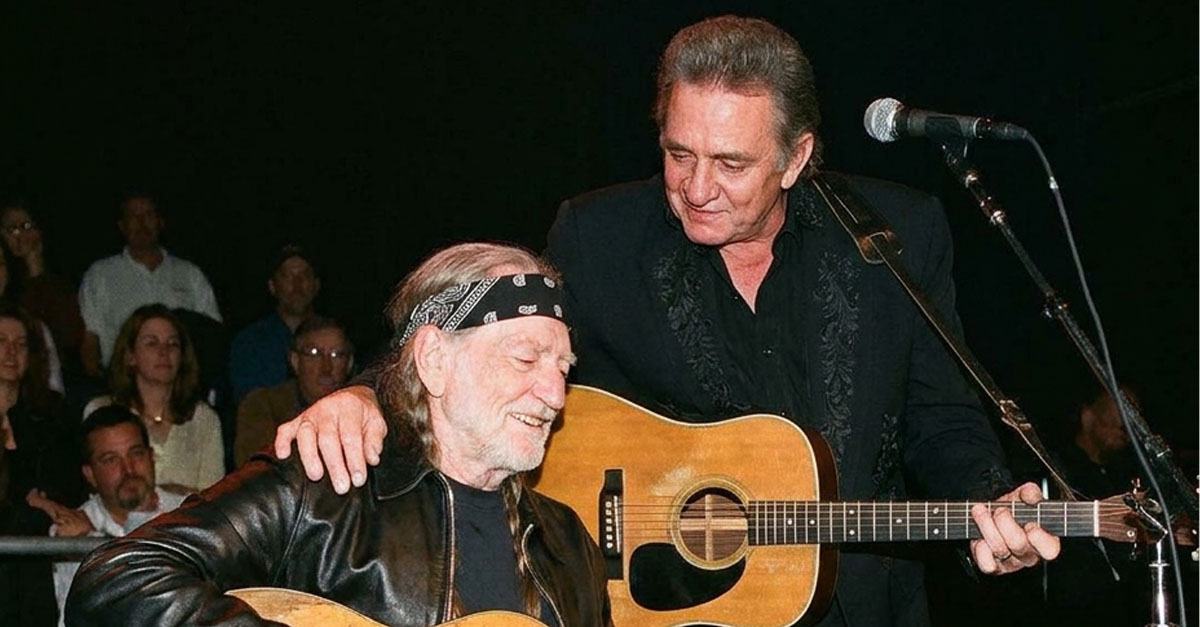
Willie Nelson has spent a lifetime singing about the road, the people who travel it, and the farewells that eventually come. Now, at 93, he is the last surviving member of the Highwaymen’s celebrated quartet: Nelson, Waylon Jennings, Johnny Cash, and Kris Kristofferson. Each of his friends is gone—Jennings in 2002, Cash in 2003, and Kristofferson in 2024—yet Nelson continues to perform.
At Farm Aid in Virginia Beach on Saturday, he sang “Last Leaf on the Tree,” the title track of his 2024 album. Written by Tom Waits, the song takes the familiar image of a tree’s final leaf and turns it into a meditation on mortality, endurance, and memory. In Nelson’s hands, it sounded less like a goodbye than a statement of presence.
The Highwaymen and a remarkable musical partnership
The Highwaymen brought together four distinctive figures in American music. Nelson, Jennings, Cash, and Kristofferson had each built major careers of their own before recording together. Their shared identity was not simply a supergroup label: they were artists whose songwriting and performances helped shape country music and its wider cultural reach.
Their best-known song, “Highwayman,” was written by Jimmy Webb. Its four verses imagine a soul returning in different forms across time, giving each singer a separate part to inhabit. The song’s perspective made mortality central to the group’s public image, even as its members were very much alive and working. Over the years, the Highwaymen recorded three studio albums and toured together, creating a lasting record of their friendship and musical chemistry.
Nelson’s survival of all three partners is a fact of chronology, not a measure of how much he valued them. He has spoken warmly of his fellow musicians and of the companionship they shared. Their absences make his continued presence especially affecting: the history of the group now rests, in part, with the one member still here to sing.
“Last Leaf on the Tree”: a song about staying
Tom Waits wrote “Last Leaf on the Tree,” and Nelson made it the title track of his 2024 album. The image at its center is simple: after autumn has stripped a tree bare, one leaf remains. It is an image of vulnerability, but also of persistence. The leaf is exposed to the weather and aware that it cannot remain forever, yet it is still there.
That tension suits Nelson’s interpretive style. His singing has long favored character over polish: a relaxed phrasing, a distinctive voice, and an ability to make a line sound as if it has been lived rather than merely performed. A song about aging and mortality can easily become sentimental. Nelson’s approach instead lets the image carry its own weight.
He has said that he wanted to face death head-on with the album, while also making clear that he did not feel alone. That distinction matters. The record does not present mortality as something to ignore, but neither does it treat it as a reason to withdraw from life. It acknowledges loss while leaving room for friendship, music, and connection.
An album that looks directly at mortality
By the time “Last Leaf on the Tree” was released, Nelson had already spent decades writing and singing about death, memory, and what people leave behind. The album gathers those subjects into a particularly direct late-career statement. Its title suggests a person who has outlasted nearly everyone around them, but the record’s emotional center is not merely survival. It is the effort to understand what survival means.
That perspective can be educational as well as moving. Nelson’s work offers a window into how popular music handles aging: not as a single dramatic event, but as a continuing adjustment to changing bodies, changing communities, and the absence of loved ones. A song can hold those realities without offering a tidy answer. It can give listeners language for thinking about them—and a way to share that thought with others.
Nelson’s comments about not feeling alone add another layer. The tree may appear solitary, but the song arrives through the voices of its writer, its interpreter, and the audience listening. Music turns private reflection into a shared experience. At a live show, that process becomes visible: one person sings, and a crowd recognizes something of its own life in the words.
The line that turns loss into a promise
One line has especially resonated with listeners: the speaker says that if someone ever cuts down the tree, they will show up in a song. It is a compact expression of how music preserves a presence. A person may die, and a tree may fall, but a song can keep a voice, a memory, or a feeling in circulation.
At 93, that line can sound like more than a poetic image. Nelson has outlived three friends with whom he shared a stage, and his career has already become part of the country’s musical memory. When he sings about appearing in a song after the tree is gone, listeners naturally hear an echo of that legacy.
Still, it is important not to turn the performance into a prediction or a valedictory. Nelson is not simply a symbol of survival. He is an artist continuing to work, to choose songs, and to meet an audience in the present. The power of the line comes partly from that immediacy: the person singing it is still here.
Why the performance matters
The Farm Aid performance brought together several strands of Nelson’s life. Farm Aid, the organization he co-founded in 1985 with Neil Young and John Mellencamp, connects music with support for family farmers and a broader conversation about the food system. Nelson’s appearance there reflects a longstanding commitment that extends beyond the stage.
Against that setting, “Last Leaf on the Tree” could be heard as both personal and communal. It spoke to Nelson’s own experience of loss, but its central image belongs to anyone who has watched a family member, friend, or community change over time. The song does not erase the people who are gone. Instead, it asks what can still be carried forward—in memory, in music, and in the relationships that remain.
Still here, still singing
Waylon Jennings died in 2002, Johnny Cash in 2003, and Kris Kristofferson in 2024. Willie Nelson remains the last surviving Highwayman, a fact that makes every shared song and every reunion of their voices feel newly precious.
But “Last Leaf on the Tree” is not only about outliving others. It is about meeting mortality honestly while continuing to take part in the world. Nelson has said he wanted to face death directly and that he never felt alone. When he sings the line about returning in a song if the tree is cut down, it lands as an image of artistic legacy—and, at 93, as a promise of presence.